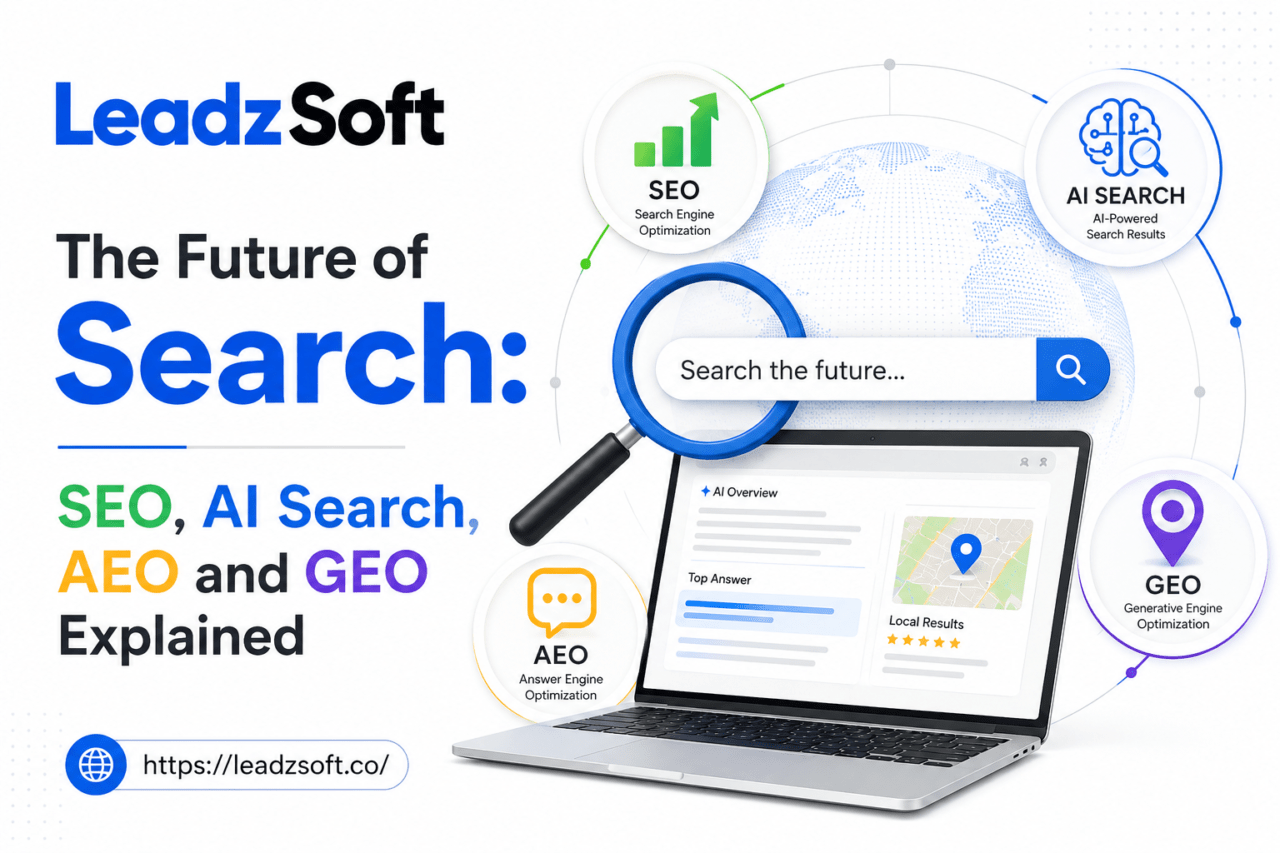
The Future of Search: SEO, AI Search, AEO and GEO Explained
Introduction: The Search Landscape is Evolving
The way people search online is fundamentally changing. Google’s algorithm updates, artificial intelligence integration, and emerging search technologies have created a complex ecosystem that goes far beyond traditional SEO. If you’re running a business in 2026, you need to understand four critical pillars: SEO, AI Search, AEO, and GEO.
At LeadzSoft, we’ve helped hundreds of businesses navigate this transformation. The companies winning today aren’t just optimizing for search engines—they’re optimizing for artificial intelligence, understanding user intent at the deepest level, and mastering location-based strategies that drive real conversions.
This comprehensive guide breaks down exactly what you need to know about the future of search, backed by industry trends, expert insights, and actionable strategies you can implement immediately.
Part 1: Traditional SEO – The Foundation That Still Matters
What is SEO in 2026?
Search Engine Optimization remains the backbone of digital visibility. However, SEO in 2026 has evolved significantly from keyword-stuffing and backlink farms. Modern SEO is about creating comprehensive digital experiences that satisfy both algorithms and humans.
Current SEO Fundamentals:
Technical SEO Excellence
Technical SEO ensures your website is crawlable, indexable, and fast. Google’s Core Web Vitals continue to be ranking factors, meaning your site speed, responsiveness, and visual stability directly impact search visibility.
Key Technical SEO Metrics:
- Page Speed: Websites loading under 2.5 seconds see 40% higher bounce rates than slower sites
- Mobile-First Indexing: Over 88% of searches now occur on mobile devices
- SSL Security: HTTPS is still a ranking signal and trust indicator
- Site Structure: Clear hierarchy and internal linking
- XML Sitemaps: Proper indexing of all important pages
- Robots.txt: Correct crawl directives
Content Authority and Topical Relevance
Google now rewards “topical authority”—the depth and breadth of coverage on specific subjects. Rather than thin, superficial content, search engines favor comprehensive topic clusters where a pillar page links to deeper, related content.
Example of Topical Authority: Instead of writing one article about “SEO tips,” create a pillar page covering “Complete SEO Guide for 2026” and link it to specific deep-dives like:
- Technical SEO Best Practices
- Content Strategy for Rankings
- Link Building for Enterprise Sites
- E-E-A-T Signals and Authority Building
E-E-A-T: Experience, Expertise, Authoritativeness, Trustworthiness
Google’s search quality raters now heavily evaluate E-E-A-T, especially for YMYL (Your Money or Your Life) content affecting health, finance, and safety.
Building E-E-A-T:
- Experience: Demonstrate real-world application of strategies
- Expertise: Show credentials, certifications, and professional history
- Authoritativeness: Earn recognition from industry peers and media
- Trustworthiness: Transparent methodology, sourced claims, updated information
Search Intent Alignment
Modern SEO obsesses over understanding what users actually want when they search. The four main intent types are:
- Informational: Users want knowledge (“How does SEO work?”)
- Navigational: Users want to reach a specific website (“LeadzSoft blog”)
- Commercial: Users researching before purchase (“Best SEO agency in UAE”)
- Transactional: Users ready to buy (“Hire SEO services”)
Matching content to intent is now non-negotiable.
Part 2: AI Search – The Intelligent Query Revolution
Understanding AI-Powered Search Engines
AI Search represents a paradigm shift from traditional keyword-based retrieval to semantic, conversational, and predictive search. Rather than matching keywords, AI understands context, nuance, and user intent with remarkable accuracy.
How AI Search Differs from Traditional SEO
| Factor | Traditional SEO | AI Search |
|---|---|---|
| Search Method | Keyword matching | Semantic understanding & context |
| Result Format | List of blue links | Conversational answers & summaries |
| User Interaction | Single query | Multi-turn conversations |
| Understanding | Surface-level keywords | Deep contextual comprehension |
| Ranking Signal | Backlinks, keywords, topical authority | Relevance, accuracy, helpfulness, source credibility |
Major AI Search Players
Google SGE (Search Generative Experience)
Google’s AI-powered search integration generates AI summaries alongside traditional search results. These “AI Overviews” synthesize information from multiple sources, changing how content gets discovered.
Impact on Businesses: Website visibility depends not just on ranking #1 but on being cited by Google’s AI. High-quality, well-sourced content gets featured in AI overviews.
Optimization for Google SGE:
- Provide authoritative, comprehensive answers
- Include original research and data
- Use clear, concise language
- Cite sources properly
- Structure content for AI parsing
Perplexity AI
Perplexity conducts searches and provides AI-powered answers with source citations. It’s particularly effective for research, analysis, and comparison queries.
Perplexity Optimization:
- Create in-depth research content
- Provide detailed comparisons and analysis
- Include data, statistics, and findings
- Make sources easy to identify and cite
Microsoft Copilot (Bing Integration)
Microsoft has integrated advanced AI into Bing search, offering conversational responses and real-time information synthesis.
Bing/Copilot Optimization:
- Optimize for conversational queries
- Provide answers to follow-up questions
- Include practical, actionable information
- Build presence on Bing Webmaster Tools
Anthropic’s Claude and Other Emerging Platforms
Specialized AI models are now building search-adjacent features, creating new discovery pathways.
The “Lost Content” Problem in AI Search
One critical challenge: when AI systems synthesize information, they cite sources but may reduce click-through traffic to websites. A query that traditionally sent traffic to 5-10 websites now might send users nowhere if the AI answer satisfies them completely.
Strategic Response: Create content so authoritative and unique that AI systems must cite your brand specifically.
Key tactics:
- Original research and proprietary data
- Expert opinions and interviews
- Unique methodologies and frameworks
- Case studies with measurable results
- Data visualizations and interactive tools
Part 3: AEO – Answer Engine Optimization
What is AEO?
Answer Engine Optimization (AEO) is optimizing content specifically for AI-powered answer engines rather than traditional search rankings. While SEO optimizes for search visibility, AEO optimizes for being cited and recommended by AI systems.
Why AEO Matters (and Why It’s Replacing Pure Keyword SEO)
- Answer engines provide AI-generated responses that cite sources
- Users increasingly interact with these platforms first
- Traditional “ranked position” becomes less important than “being cited”
- Content relevance and accuracy become more valuable than keyword optimization
- First-mover advantage for brands adopting AEO now
Core Principles of AEO
Direct Answer Optimization
Structure your content to directly answer specific questions. Use FAQ schemas, clear headers, and concise answer paragraphs.
Direct Answer Format:
Question: What is the difference between SEO and AEO?

Answer: SEO (Search Engine Optimization) optimizes websites
to rank higher in Google's search results by improving technical
factors, content quality, and authority signals. AEO (Answer Engine
Optimization) optimizes content to be cited by AI systems when they
generate answers to user queries, focusing on clarity, accuracy,
and source credibility.
Provide Original Insights
AI systems are trained to identify and elevate original research, data, and unique perspectives. Generic content copied from competitor blogs won’t be cited as effectively.
Creating Original Content:
- Conduct original surveys and research
- Share proprietary data and findings
- Interview industry experts and thought leaders
- Document case studies with measurable results
- Develop unique frameworks and methodologies
- Analyze trends with exclusive data
Cite Sources and Ensure Verifiability
AI systems reward content that is transparent, well-sourced, and verifiable. Use:
- Proper citations and attribution
- Links to authoritative sources
- Structured data (Schema markup)
- Author expertise indicators
- Transparent methodology explanation
- Data source documentation
Content Depth with Clarity
AEO content needs both depth and brevity. Provide:
- Comprehensive information (1,500-3,500+ words for pillar content)
- Quick-scan summaries (key points in 2-3 sentences)
- Clear section headers and logical flow
- Bullet points for scanability
- Visuals and diagrams for complex concepts
- Code blocks or examples for technical content
Entity Relationship Clarity
AI systems understand entities (people, places, organizations, concepts) and their relationships. Clearly define:
- Who you are (author/business entity)
- Your expertise and credentials
- How you relate to the topic
- Connections between related concepts
- Your unique perspective or methodology
AEO Content Strategy: A Practical Example
Topic: “AI SEO Services” (a core LeadzSoft offering)
Traditional SEO Approach
- Write one comprehensive article
- Optimize for keywords: “AI SEO,” “artificial intelligence SEO services,” etc.
- Build backlinks to rank higher
- Hope for position #1
AEO Approach
Research & Original Insights:
- Publish original research: “2026 AI SEO Adoption Report”
- Survey 500+ agencies on AI tool usage
- Document real results from your clients
Content Cluster Strategy:
- Pillar Page: “AI SEO Services Explained” (comprehensive overview)
- Deep Dives:
- “How AI Analyzes Competitor Strategies”
- “AI Tools for Keyword Research: 2026 Comparison”
- “Machine Learning in Google’s Ranking Algorithms”
- “Case Studies: How AI SEO Generated Results”
Optimization Tactics:
- Use structured data to define LeadzSoft’s expertise
- Include expert quotes from your team
- Link to authoritative sources validating your claims
- Document methodology transparently
- Update findings quarterly with new data
Result: Higher AI citations, stronger source credibility, more authority
Part 4: GEO – Geographic and Local Search Optimization
Understanding GEO in Modern Search
Geo-targeting or Geographic Optimization (GEO) focuses on appearing in search results for location-specific queries. This is increasingly important as:
- 46% of all searches now include geographic intent
- Mobile usage drives location-based search
- “Near me” queries are growing 50% year-over-year
- Local AI search is emerging with location awareness features
- Businesses serving multiple regions need geo-specific visibility
Types of Geographic Search Intent
Local Queries
Location-based searches with immediate service needs:
- “SEO agency near me”
- “Dentist in Dubai”
- “Best restaurants in Lahore”
- “Car repair shop 10 miles away”
Optimization focus: Google Business Profile, local citations, location-specific reviews
Regional/Country Queries
Geographic scope covering wider areas:
- “SEO services in UAE”
- “Digital marketing company UK”
- “Web developers in Pakistan”
- “Best agencies in California”
Optimization focus: Regional landing pages, country-specific content, local media coverage
Multi-location Queries
Searches spanning multiple geographic areas:
- “SEO services in USA, UK, UAE”
- “Global digital agencies with UK office”
- “Multinational web development firms”
Optimization focus: Global brand authority, multi-location service pages, international experience
GEO Strategy for Multi-Location Businesses
If You Serve Multiple Markets: LeadzSoft’s approach exemplifies this. You offer services globally but need to appear in local searches.
Strategy Component 1: Google Business Profile (GBP) Excellence
Optimize each location’s profile:
- Create and verify GBP listings for each physical or service location
- Use consistent Name, Address, Phone (NAP) across all platforms
- Add location-specific photos, posts, and services
- Encourage local reviews and respond to all feedback
- Keep information updated in real-time
GBP Optimization Checklist:
- ✅ Verified business ownership
- ✅ Accurate NAP information
- ✅ 10+ high-quality photos per location
- ✅ Comprehensive service descriptions
- ✅ Weekly posts (minimum)
- ✅ Respond to 100% of reviews
- ✅ Fill out all attributes
- ✅ Add Q&A responses
Strategy Component 2: Location-Specific Landing Pages
Create dedicated pages for each market you serve. Examples for LeadzSoft:
/seo-services-uae//seo-services-usa//seo-services-uk//digital-marketing-lahore//seo-services-australia/
Each location page should include:
- Local testimonials and case studies
- Local business references and examples
- Location-specific keyword optimization
- Local pain points and solutions
- Regional expertise and team
- Local contact information
- Regional pricing information
- Local market trends and insights
Strategy Component 3: Citation Building in Local Directories
Submit your business information to local directories consistently:
- Major directories: Yelp, Google Business, Apple Maps
- Industry-specific: Industry association directories
- Local directories: Chamber of Commerce, local business councils
- Regional B2B: Regional business platforms
- Local directories: City-specific business listings
Citation Building Best Practices:
- Use consistent NAP across all citations
- Ensure all citations link back to website
- Complete all available fields
- Use location-specific categories
- Monitor for accuracy and respond to changes
Strategy Component 4: Local Link Building
Earn links from local businesses, news outlets, and community organizations:
- Sponsor local events (get coverage and links)
- Partner with complementary local businesses
- Get featured in local business publications
- Join local industry associations
- Contribute to local community initiatives
- Participate in local online communities
Local Link Opportunities:
- Local chamber of commerce
- Small business associations
- Community nonprofits
- Local news outlets
- Industry-specific local groups
- University/college partnerships
Strategy Component 5: Localized Content and Community Engagement
- Write about local market trends and predictions
- Feature local clients (with permission and case studies)
- Participate in local online communities and forums
- Create location-specific blog content
- Sponsor local events and document participation
- Build relationships with local influencers
Content Ideas:
- “State of [City] Digital Marketing 2026”
- “Local business success stories”
- “Regional industry trends”
- “How [City] businesses are adapting to AI search”
Strategy Component 6: Leveraging Location-Based AI Search
Emerging AI search tools will incorporate location data. Prepare by:
- Clearly stating service areas in your website schema
- Creating location-specific expertise signals
- Building relationships with local media and influencers
- Documenting local results and case studies
- Optimizing for “near me” conversational queries
Real-World GEO Example: LeadzSoft’s Global Strategy
LeadzSoft serves clients across UAE, USA, UK, Saudi Arabia, and Australia. Their GEO strategy includes:
Global Homepage:
- Highlights international expertise
- Shows trusted clients worldwide
- Demonstrates multi-country experience
Regional Hub Pages:
- “SEO Services in UAE”
- “SEO Services in USA”
- “SEO Services in UK”
- “SEO Services in Saudi Arabia”
- “SEO Services in Australia”
Regional Content:
- Each region has dedicated blog posts
- Addresses region-specific challenges
- Considers local regulations and market conditions
- Features regional case studies
Google Business Profile:
- Multiple verified listings for different service locations
- Active maintenance and updates
- Regional phone numbers where applicable
- Geotargeted content and offers
Regional Authority:
- Partner with regional media outlets
- Sponsor regional events
- Build relationships with local industry groups
- Earn mentions in regional publications
The Integration: How SEO, AI Search, AEO, and GEO Work Together
The Holistic Search Strategy Framework
Modern success requires integrating all four pillars. Here’s how they interact:
┌─────────────────────────────────────────────┐
│      COMPREHENSIVE SEARCH VISIBILITY        │
├─────────────────────────────────────────────┤
│                                             │
│  ┌──────────────────────────────────────┐  │
│  │  SEO (Google Rankings)               │  │
│  │  ├─ Technical excellence             │  │
│  │  ├─ Topical authority                │  │
│  │  ├─ E-E-A-T signals                  │  │
│  │  └─ Content quality                  │  │
│  └──────────────────────────────────────┘  │
│                  +                          │
│  ┌──────────────────────────────────────┐  │
│  │  AI Search (Answer Engines)          │  │
│  │  ├─ Source citations                 │  │
│  │  ├─ Semantic relevance               │  │
│  │  ├─ Conversational matches           │  │
│  │  └─ Information authority            │  │
│  └──────────────────────────────────────┘  │
│                  +                          │
│  ┌──────────────────────────────────────┐  │
│  │  AEO (AI Optimization)               │  │
│  │  ├─ Direct answer format             │  │
│  │  ├─ Original insights                │  │
│  │  ├─ Entity clarity                   │  │
│  │  └─ Source credibility               │  │
│  └──────────────────────────────────────┘  │
│                  +                          │
│  ┌──────────────────────────────────────┐  │
│  │  GEO (Location Targeting)            │  │
│  │  ├─ Local search visibility          │  │
│  │  ├─ Regional relevance               │  │
│  │  ├─ Geographic authority             │  │
│  │  └─ Multi-location optimization      │  │
│  └──────────────────────────────────────┘  │
│                  =                          │
│        MAXIMUM DIGITAL VISIBILITY           │
│    (Ranking, Citations, Conversions)        │
│                                             │
└─────────────────────────────────────────────┘
Practical Integration Example
Business Goal: A healthcare clinic in Dubai wants to be found by patients searching for their services.
Integrated Strategy Implementation
1. SEO Component
- Optimize website for “dermatologist in Dubai”
- Build topical authority around dermatology topics
- Establish E-E-A-T through doctor credentials
- Get patient testimonials and reviews
- Ensure technical excellence and mobile optimization
2. AI Search Component
- Create content answering common questions (“What is acne treatment?”)
- Make answers comprehensive enough that AI systems cite the clinic
- Provide research-backed recommendations
- Include patient success stories
3. AEO Component
- Publish original content: patient survey data
- “63% of dermatology patients research online before booking”
- Create treatment methodology videos
- Interview expert doctors on dermatology trends
- Provide direct answers in structured format
4. GEO Component
- Verify Google Business Profile for Dubai location
- Create clinic-specific service pages
- Get featured in Dubai health directories
- Earn links from Dubai media and healthcare networks
- Add clinic address and phone in all citations
Expected Results:
- Appears in Google search results for relevant keywords
- Gets cited in AI answer engines when questions are asked
- Shows up prominently in Perplexity recommendations
- Dominates “dermatologist near me” local searches
- Receives qualified patient inquiries
Content Gap Analysis: Addressing User Needs You Haven’t Covered
Before implementing this strategy, audit what users need that your content doesn’t provide.
Questions People Search But You Haven’t Answered
For Digital Marketing Agencies (like LeadzSoft):
- “How much does SEO cost?” (pricing transparency)
- “How long does SEO take?” (timeline expectations)
- “SEO vs PPC vs social media” (comparative analysis)
- “What if my current agency isn’t getting results?” (switching guide)
- “How to brief an SEO agency?” (preparation guide)
- “What metrics matter in SEO?” (success measurement)
- “Is SEO worth it?” (ROI justification)
- “How to find a trustworthy SEO agency?” (vetting guide)
For Service Providers (Clinics, Law Firms, Ecommerce):
- “How to choose [service] in [location]?” (decision guide)
- “What should I expect?” (process explanation)
- “How much does [service] cost?” (pricing)
- “[Service] near me” (local discovery)
- “Before and after [service]” (results showcase)
Creating Gap-Filling Content
For each content gap, create:
- Dedicated resource page answering the specific question
- Internal linking strategy connecting it to related content
- AI-optimized structure (questions, clear answers, sources)
- Original elements (data, case studies, expertise)
- Regular updates as information evolves
- Visual elements (infographics, diagrams, videos)
Avoiding Common Content Mistakes
What NOT to Do
❌ Thin, Superficial Content
Bad: “10 SEO Tips Everyone Should Know” (generic, skimmable, uninformative)
Good: “Technical SEO Audit Checklist 2026: Complete Site Analysis Template with Implementation Framework” (specific, useful, actionable)
❌ Keyword Stuffing
Bad: Repeatedly using “SEO services Dubai” unnaturally throughout content, disrupting readability
Good: Using natural language with semantic variations and related terms: “SEO services,” “search optimization,” “ranking improvement,” “organic visibility”
❌ Irrelevant Information
Bad: Including information just because you have space or keywords to optimize
Good: Including only information that directly serves the reader’s intent and supports your main argument
❌ Unsourced Claims
Bad: “Studies show 87% of people prefer…” (no source cited, unprovable)
Good: “According to HubSpot’s 2026 Marketing Report, 87% of marketers increased their content budget…” (cited, verifiable, traceable)
❌ Outdated Information
Bad: Publishing content and never updating it as algorithms and tools change
Good: Reviewing and updating content quarterly or when major changes occur, with clear “last updated” dates
❌ Inconsistent Author Information
Bad: No author byline or unclear who wrote the piece, no credentials shown
Good: Clear author bio with credentials, photo, and expertise indicators
❌ Poor User Experience
Bad: Long paragraphs, no headers, auto-playing videos, intrusive ads, poor mobile optimization
Good: Scannable format, clear navigation, intentional multimedia, fast loading, mobile-responsive design
Measuring Success: The Right KPIs for This Strategy
SEO KPIs
Visibility Metrics:
- Organic traffic: Sessions from unpaid search
- Keyword rankings: Positions for target queries (track top 20, top 3, #1)
- Search impressions: Total times your site appears in search results
- Visibility score: Combined metric tracking all ranking positions
Engagement Metrics:
- Click-through rate (CTR): Percentage of impressions that become clicks
- Average position: Average ranking position for tracked keywords
- Bounce rate: Percentage of sessions with single page view
Conversion Metrics:
- Conversion rate: Percentage of traffic converting to leads/sales
- Cost per lead: Total SEO spend divided by leads generated
- Lead quality score: Based on conversion likelihood
AI Search KPIs
Citation Metrics:
- Citation tracking: Count of mentions in AI answer engine responses
- Citation frequency: How often your site is cited
- Citation visibility: Whether you’re the primary or secondary source cited
- AI referral traffic: Sessions specifically from Perplexity, Claude, or other AI platforms
Reach Metrics:
- Covered queries: Questions where your content appears in AI responses
- AI SERP features: Appearances in AI-generated snippets and overviews
AEO KPIs
Feature Visibility:
- SERP feature visibility: FAQ, People Also Ask, featured snippets
- Featured snippet rankings: Positions in Google’s answer box
- Position Zero rankings: Top answer position in search results
Technical Metrics:
- Schema markup coverage: Percentage of content with proper structured data
- FAQ implementation: Number of FAQ items successfully marked up
- Entity definitions: Clarity and completeness of entity markup
GEO KPIs
Local Visibility:
- Local search rankings: Positions in local 3-pack results
- Local pack appearances: Times your business shows in local carousel
- Local search impressions: Search impressions with geographic intent
GBP Metrics:
- Google Business Profile engagement: Q&A responses, review volume, call clicks
- Review volume: New reviews per month
- Review ratings: Average star rating and sentiment analysis
Location Performance:
- Location-specific traffic: Sessions from users with location-based intent
- Service area coverage: Visibility in all target geographic markets
- Local lead volume: Qualified leads from local searches
Overall Business KPIs
Quality Metrics:
- Lead quality: Score and conversion rates of leads from search
- Customer satisfaction: NPS, CSAT, testimonials from search leads
Financial Metrics:
- Customer acquisition cost (CAC): Total marketing spend ÷ new customers
- Lifetime value (LTV): Total revenue from a customer
- Return on investment (ROI): Revenue generated ÷ marketing spend
- Marketing attribution: Revenue attributed to organic search
Growth Metrics:
- New customers from search: Number of new customers acquired via search
- Revenue from organic search: Total revenue generated from organic traffic
- Growth rate: Month-over-month improvement in key metrics
Actionable Next Steps: Your 90-Day Implementation Plan
Month 1: Foundation Building
Week 1-2: Audit and Analysis
- Complete comprehensive SEO technical audit
- Audit current website against E-E-A-T standards
- Analyze competitor content and strategies
- Research target keywords and search intent
- Document current organic rankings
Week 2-3: Setup
- Create or verify Google Business Profile
- Set up analytics and tracking (GA4, Search Console)
- Establish baseline metrics for all KPIs
- Create content calendar and editorial plan
Week 3-4: Strategy
- Conduct content gap analysis
- Map topical authority structure
- Define target keywords and intents
- Plan location-specific content
Month 2: Content Strategy and Optimization
Week 1-2: Content Creation
- Create 5-10 gap-filling content pieces
- Develop location-specific landing pages
- Create pillar page with cluster content
- Produce original research or data
Week 2-3: Technical Optimization
- Implement structured data (Schema markup)
- Optimize existing high-value pages for AI Search
- Improve site speed and Core Web Vitals
- Enhance mobile experience
Week 3-4: Authority Building
- Establish author expertise signals
- Create author bios with credentials
- Document methodology and frameworks
- Prepare case studies with results
Month 3: Optimization and Scaling
Week 1-2: Local Optimization
- Build local citations across directories
- Optimize GBP listings for all locations
- Create location-specific content
- Implement local schema markup
Week 2-3: Link Building
- Launch targeted link-building campaign
- Build local relationship and partnerships
- Pursue earned media coverage
- Develop strategic partnerships
Week 3-4: Monitoring and Refinement
- Track AI search mentions and citations
- Monitor keyword rankings and visibility
- Measure content performance
- Plan content update schedule
- Analyze user behavior and conversions
Why Partner with LeadzSoft for Your Search Strategy
Navigating SEO, AI Search, AEO, and GEO simultaneously requires expertise, tools, and ongoing optimization. LeadzSoft provides comprehensive solutions.
Comprehensive Services
AI SEO Services
- Leveraging artificial intelligence for smarter optimization
- AI-powered competitor analysis
- Machine learning-based keyword research
- Predictive analytics for strategy
SEO Strategy & Consulting
- Custom strategies aligned with your business goals
- Competitive landscape analysis
- Opportunity identification
- Ongoing strategic guidance
Technical SEO
- Site speed and Core Web Vitals optimization
- Security and SSL implementation
- Indexability and crawlability fixes
- Site structure and architecture
Content Development
- Original research and data collection
- Authoritative article writing
- Gap-filling content creation
- Visual content and infographics
Local SEO & GEO
- Multi-location visibility optimization
- Geographic targeting strategies
- Local citation building
- Google Business Profile optimization
E-E-A-T Enhancement
- Building authority and trust signals
- Expert positioning
- Credibility documentation
- Author expertise development
Global Expertise
- Proven results in UAE, USA, UK, Saudi Arabia, Australia
- Multi-market experience
- Cultural and regional understanding
- International SEO best practices
Proven Results
Our clients achieve:
- 180% increase in organic traffic within 6-9 months
- 64% boost in conversion rates through better targeting
- Multi-location rankings for regional and global queries
- Consistent top 3 placements for high-intent keywords
- 3-5x ROI on marketing investment
White-Glove Process
1. Deep Dive Audit
- Understanding your market, competitors, and opportunities
- Comprehensive analysis of current state
- Identification of quick wins and long-term opportunities
2. Strategy Development
- Custom roadmap covering all four pillars
- Prioritized action plan
- Resource and timeline allocation
- Clear success metrics
3. Transparent Reporting
- Weekly/monthly updates with real metrics
- Dashboard access to all KPIs
- Regular strategy review and adjustment
- Clear communication of progress
4. Continuous Optimization
- Adapting to algorithm changes and new opportunities
- A/B testing of strategies
- Content updates and refreshes
- Ongoing competitor analysis
5. Expert Support
- Direct access to SEO specialists and strategists
- Regular consultation and guidance
- Training for your internal team
- Collaborative problem-solving
Conclusion: The Future of Search is Here
The evolution from pure SEO to a comprehensive strategy encompassing AI Search, AEO, and GEO isn’t a distant future—it’s happening now. Businesses adapting today will dominate search visibility tomorrow.
The Four Pillars Work Together
- SEO gives you visibility in traditional search results
- AI Search gets you cited by answer engines
- AEO optimizes you for how AI systems actually work
- GEO captures location-based and regional intent
Rather than choosing between them, successful businesses integrate all four into a cohesive strategy that addresses user intent at every stage of the customer journey.
Your Next Steps
1. Audit where you stand today:
- Are you ranking well in Google but missing AI search opportunities?
- Are you visible locally but unknown regionally?
- Are you getting traffic without conversions?
2. Identify priorities: The answers determine your priority. But one truth is universal: the businesses winning in search today are those who stopped thinking about keywords and started thinking about user intent, AI understanding, and geographic relevance.
3. Take action: At LeadzSoft, we’ve built our entire approach around these principles. Whether you need a comprehensive overhaul or optimization of existing strategy, we’re here to help you not just rank—but dominate—in the search landscape of 2026 and beyond.
Ready to Implement Your Search Strategy?
Contact LeadzSoft Today
📞 Phone: +92 334 5206127
📧 Email: services@leadzsoft.co
💬 Chat: Available 24/7
Let’s build your visibility across SEO, AI Search, AEO, and GEO. Your competitors won’t wait—neither should you.
FAQ Section: Common Questions Answered
Q: How does AI Search affect my current SEO efforts?
A: AI Search changes how content gets discovered but doesn’t eliminate SEO. Your technical SEO, topical authority, and content quality remain essential. The addition is optimizing for how AI systems interpret and cite your content. Think of it as expanding SEO from “rank in Google” to “be cited by AI systems.”
Q: Do I need to choose between SEO and AEO?
A: No. Best practice is integration. AEO builds on SEO foundations—quality content, technical excellence, and authority. AEO adds optimization specifically for AI answer engines. You’re essentially expanding your reach to new platforms.
Q: How important is GEO for global businesses?
A: Extremely important. Even global businesses need strong local presence in each market. Geographic optimization increases relevance and trust in local search results and AI recommendations. Customers in specific regions want to know you serve their area.
Q: How long until I see results?
A: SEO typically shows meaningful results in 3-6 months. AEO and GEO integration may show wins within 4-12 weeks as these strategies are newer and have less competition. Consistency and quality matter more than timeline. Most improvements are gradual and cumulative.
Q: How often should I update my content?
A: Quarterly minimum for evergreen content. Review for accuracy, update statistics, add new information, and improve formatting. High-performing pages should be refreshed monthly. Mark update dates so search engines and AI systems know content is current.
Q: What’s the difference between SEO, AEO, and GEO?
A:
- SEO optimizes for Google rankings through technical excellence, content quality, and authority
- AEO optimizes for AI answer engines through clear answers, original insights, and proper sourcing
- GEO optimizes for location-based visibility through local citations, geographic targeting, and regional authority
They’re complementary strategies, not competing ones.
Q: Which should I focus on first?
A: Start with SEO fundamentals (technical quality, content quality, E-E-A-T). Then add AEO optimization to your existing content. Finally, implement GEO if you serve multiple locations. They build on each other.
Q: How much does this cost?
A: Strategy investment varies based on business size, industry, and current state. Contact LeadzSoft for a custom proposal. Most businesses see ROI within 6-9 months.
Resources and Further Reading
Internal LeadzSoft Resources
Industry References
- Google’s E-E-A-T Guidelines
- Google Core Web Vitals Documentation
- Search Generative Experience (SGE) Overview
- Schema.org Structured Data Documentation
About the Author
LeadzSoft Digital Strategy Team
With over 10+ years of combined experience in digital marketing, AI-powered SEO optimization, and global search visibility strategies, our team has helped hundreds of businesses across UAE, USA, UK, Saudi Arabia, and Australia achieve sustainable growth through search.
Our expertise covers:
- Enterprise-level SEO strategies
- AI and machine learning applications in marketing
- Multi-location and international optimization
- E-E-A-T and authority building
- Conversion-focused content strategies
Email: services@leadzsoft.co
Phone: +92 334 5206127