
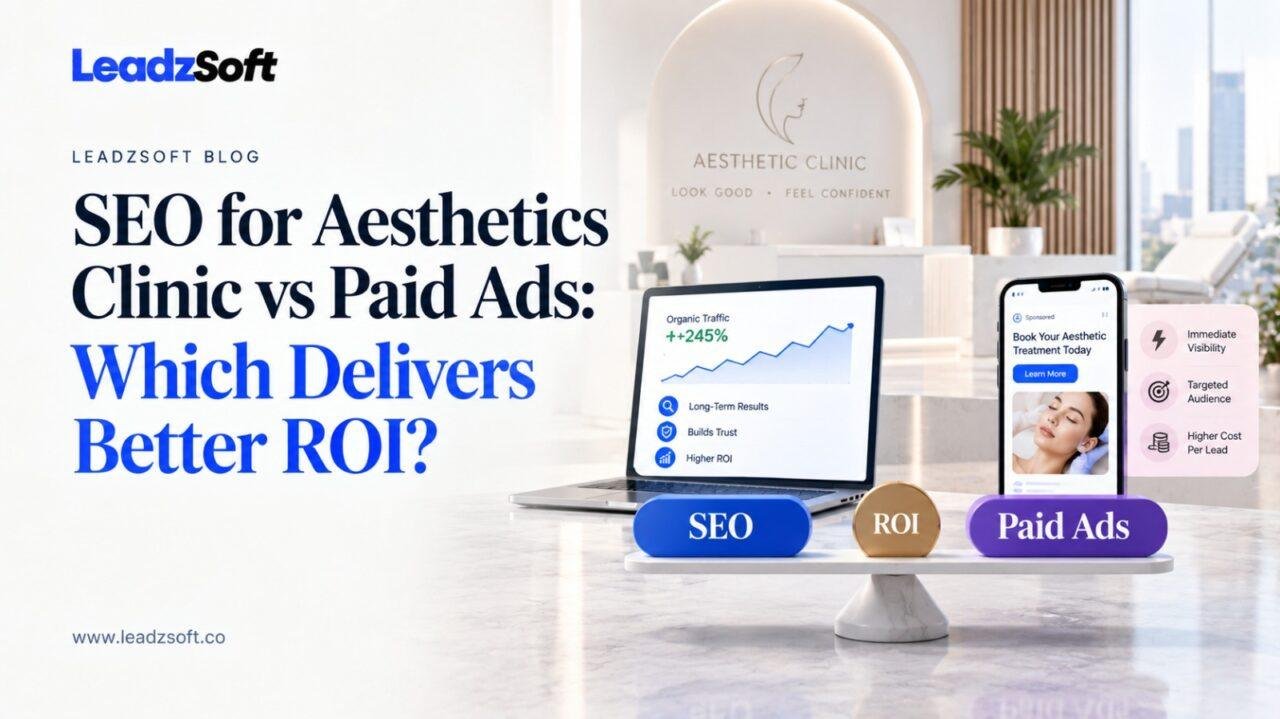
SEO for Aesthetics Clinic vs Paid Ads: Which Delivers Better ROI?
The aesthetics industry Botox, dermal fillers, laser treatments, skin rejuvenation, body contouring is more competitive than ever, and almost every patient now searches online before booking. The real question isn’t whether to market online, it’s where to put the budget first: SEO or paid ads.
Short answer: Paid ads win on speed. SEO wins on long-term cost-per-lead and sustainability. The right mix depends on how fast you need patients in the chair and how long you’re planning to run the clinic. Below is the full breakdown, a way to actually calculate your own ROI, and the parts of this decision most agencies don’t tell you about.
What Is SEO for an Aesthetics Clinic?
Search Engine Optimization (SEO) is the process of improving your website so it appears organically on Google for the searches your future patients are already typing, such as:
- Botox clinic near me
- Best skin clinic in your city
- Laser hair removal cost
- Lip filler before and after
- Is a treatment safe / painful
SEO for an aesthetics clinic covers:
- Keyword research — mapping what patients search at each stage (research vs. ready-to-book)
- On-page optimization — treatment pages structured around what patients actually want to know
- Technical SEO — site speed, mobile experience, and structured data (schema markup) so Google understands your clinic, services, and location
- Local SEO — Google Business Profile, local citations, map pack visibility
- Content marketing — educational articles that build trust before the booking
- Link building — earning credibility signals from other sites
- Google Business Profile optimization — reviews, photos, Q&A, and posts
The goal isn’t a one-time push — it’s building assets that keep generating traffic without a per-click cost.
What Are Paid Ads?
Paid advertising puts your clinic in front of patients instantly, through platforms like:
- Google Ads (Search + Local Service Ads)
- Meta Ads (Facebook & Instagram)
- YouTube Ads
- TikTok Ads
You pick an audience, set a budget, and traffic starts the same day. But every click costs money, and when the budget stops, so does the traffic.
Important and often-missed point: cosmetic and medical-adjacent advertising is more restricted than most industries. Google and Meta both apply stricter review processes to ads mentioning certain treatments, before/after imagery, or medical claims, and some campaigns get disapproved or limited in targeting as a result. If you’re planning to lead with paid ads, budget extra time for ad approval and compliant creative — this is a real friction point specific to aesthetics clinics that a generic “SEO vs Ads” comparison for other industries wouldn’t have.
SEO vs Paid Ads: Side-by-Side
| Factor | SEO | Paid Ads |
| Initial Results | Slow (typically 3–6 months to see traction) | Immediate |
| Long-Term ROI | Strong — compounds over time | Moderate — resets with budget |
| Cost Per Lead | Lower over time | Higher, and rising with competition |
| Brand Trust | High — organic results read as earned | Moderate — users know it’s paid |
| Sustainability | Traffic continues after publishing | Stops when spend stops |
| Scalability | Excellent, low marginal cost | Limited by budget |
| Approval/Compliance Friction | Low | Higher for cosmetic/medical claims |
How to Actually Calculate Your ROI
Most comparisons stop at “SEO is cheaper long-term” without showing the math. Here’s the formula to run for your own clinic:
Cost Per Lead (CPL) = Total spend ÷ Number of leads generated
Cost Per Booking = Total spend ÷ Number of patients who actually booked
ROI = (Revenue from bookings − Total marketing spend) ÷ Total marketing spend × 100
Example logic (illustrative, not a guaranteed outcome)
If you spend on paid ads and get leads at a certain cost per click, your cost per lead is fixed by that spend and won’t drop unless your ad efficiency improves. With SEO, once a page ranks, the cost per additional visitor trends toward zero — so as traffic grows, your CPL keeps falling even if your monthly SEO investment stays flat. That declining-CPL curve is the core financial argument for SEO, and it’s the number you should actually track month over month, not just “did we get more visitors.”
Track this yourself using Google Search Console (organic traffic) and your ad platform’s own reporting (paid traffic), matched against your clinic’s booking system, so you’re comparing actual patients booked — not just clicks.
Why SEO Generates Better Long-Term ROI
1. Organic Traffic Doesn’t Disappear Overnight
Unlike ads, a well-optimized page keeps ranking and pulling traffic after publication — sometimes for years — without additional spend per visitor.
2. Patients Trust Organic Results
Many users skip the “Sponsored” label and click organic results first, because they read as earned rather than paid for. Higher rankings build credibility by association.
3. Better Local Visibility
Most aesthetics clinics depend on local patients. Local SEO — an optimized Google Business Profile, consistent NAP (name, address, phone) citations, and location-specific content — helps you show up in the Google Map Pack for searches like “Botox near me” or “skin clinic in [city],” which is often where local buying decisions actually happen.
4. Educational Content Builds Authority Before the First Call
Patients rarely book cosmetic treatments on the first visit to your site. They research first — questions like “Botox side effects,” “how long do fillers last,” “is laser treatment painful.” Publishing genuinely useful answers to these positions your clinic as the expert before the patient ever picks up the phone.
Where Paid Ads Perform Better
Paid ads are the right tool when:
- You’re launching a new clinic with zero existing traffic
- You’re promoting a seasonal offer or limited-time discount
- You need to fill appointment slots quickly
- You’re testing a new service and want fast market feedback
If you need patients this month, not this quarter, ads deliver.
Hidden Costs of Paid Advertising
Beyond the ad spend itself, factor in:
- Rising cost-per-click as competition in your area increases
- Creative production (photos, video, ad copy that stays within cosmetic ad policy)
- Landing page build and optimization
- Ongoing campaign management
- A/B testing time and spend
- Audience research
These are easy to underestimate when comparing “SEO cost” to “just the ad spend number.”
Local SEO: What “Optimizing Google Business Profile” Actually Means
This gets mentioned constantly and explained rarely. In practice it means:
- Keeping your business name, address, and phone number identical everywhere online
- Adding real photos of your clinic, team, and (compliant) treatment results
- Responding to every review, positive or negative
- Posting updates and offers through GBP posts
- Filling out every relevant service and attribute field
- Collecting reviews consistently, not in a single burst
Clinics that treat this as a “set once” task instead of ongoing maintenance typically underperform in the Map Pack against competitors who stay active.
The Best Strategy: Combine Both
The clinics that grow fastest don’t pick one — they sequence both:
- Use paid ads for immediate visibility while SEO is still building
- Invest in SEO in parallel for long-term, compounding organic growth
- Publish educational content on a consistent schedule, not sporadically
- Optimize Google Business Profile continuously
- Fix technical SEO basics — site speed and mobile experience directly affect both organic rankings and ad landing page quality scores
- Track cost-per-booking (not just cost-per-click) across both channels and shift budget toward whichever is actually converting
Which Strategy Delivers Better ROI?
If you need patients this month, paid ads deliver faster. If you’re optimizing for sustainable growth and a lower cost per lead over the next 12+ months, SEO generally wins — but only if it’s executed consistently, since SEO has no shortcut for the initial 3–6 month ramp-up period.
The clinics with the strongest overall marketing performance don’t treat this as an either/or decision. They use paid ads to cover the gap while SEO compounds, then gradually shift budget as organic traffic takes over more of the lead volume.
Frequently Asked Questions
Is SEO better than Google Ads for aesthetics clinics?
SEO generally delivers better long-term ROI because it keeps generating traffic without paying per click. Google Ads is better for immediate visibility and short-term campaigns.
How long does SEO take to show results for a clinic?
Most clinics see measurable movement within 3–6 months, depending on competition in the area, site quality, and consistency of execution. It’s rarely instant.
Should a new aesthetics clinic invest in SEO or paid ads first?
A combination works best — ads for immediate leads while the clinic has no organic presence, SEO running in parallel to build the long-term asset.
Does local SEO actually help aesthetics clinics?
Yes — most patients search for treatments near their location, and Local SEO/Google Business Profile optimization is what determines Map Pack visibility for those searches.
Can SEO reduce overall marketing costs over time?
Yes, as organic rankings improve, dependence on paid clicks decreases, which lowers the average cost per lead — but this is a gradual shift, not immediate.
Are there restrictions on advertising cosmetic or medical treatments?
Yes. Google and Meta apply additional review and restrictions to ads involving medical claims, certain treatments, or before/after imagery. This can slow down or limit paid campaigns for aesthetics clinics specifically, which is a factor worth planning for before relying on ads as the primary channel.
How do I know if my SEO or ad spend is actually working?
Track cost-per-booking, not just clicks or leads — measure both channels against actual patients booked using your clinic’s scheduling data alongside Google Search Console (organic) and your ad platform’s reporting (paid).
Final Thoughts
SEO and paid advertising both have a role — ads for speed, SEO for a compounding, long-term asset. The clinics that get the best return treat this as a sequencing decision, not a one-time choice: use ads to bridge the gap while SEO ramps up, then track cost-per-booking across both to see where your budget is actually working hardest.
Want a clinic-specific breakdown of where your budget should go first? Talk to LeadzSoft about a tailored SEO strategy for your clinic.